A Trio of Photos: Floating Seaweeds at Fulford Harbour

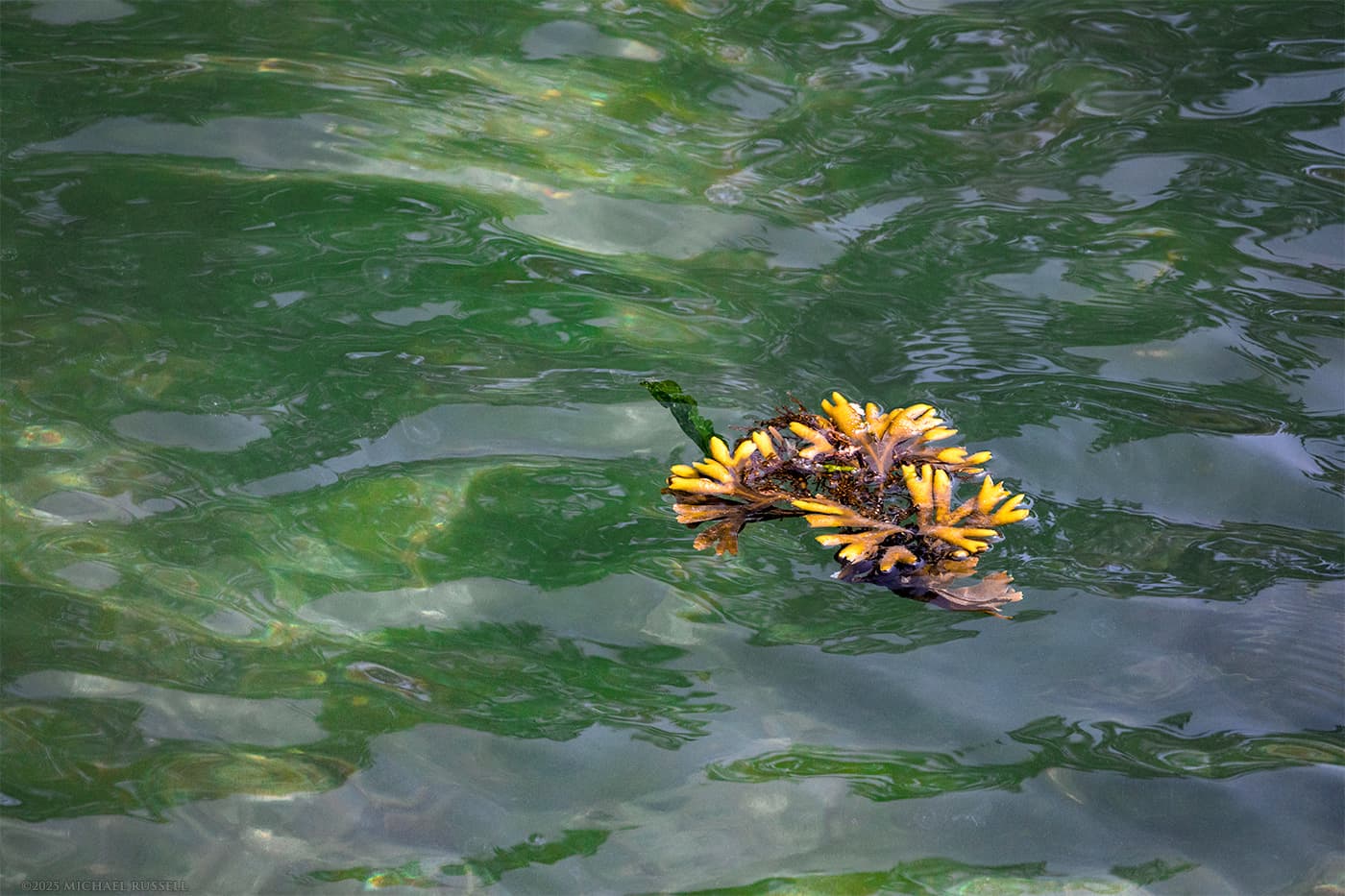
A branch of Rockweed (Fucus distichus) floating at Fulford Harbour on Salt Spring Island in British Columbia, Canada.

rockweed fucus distichus floating in the water at fulford harbour

Rockweed (Fucus distichus) floating at Fulford Harbour (Purchase)

Just over a year ago I started a series of posts that highlight 3 photos from the same area or subject or are otherwise linked. I often seem to wind up with 3 images that go together like this. I did not anticipate that it would take me over a year to make the second post, however. This time around I have 3 photos I made at Fulford Harbour on Salt Spring Island while waiting for a ferry. I was watching a Belted Kingfisher pull small fish out of a bay next to the pier I was loitering on, and saw these brown macroalgae / seaweeds floating in the water. Different sizes, different species, and very different underlying colours.

The first photograph here shows a branch of Rockweed (Fucus distichus) floating with a lighter sandy bottom transitioning to a darker one. I liked having the Rockweed on the line between the two. Rockweed is a pretty common intertidal zone macroalgae that you’ll find along rocky beaches up and down the west coast of Canada. The lighter coloured claw shaped structures (vesicles) are quite buoyant. When the seaweed is growing along the shore this helps keep the photosynthetic parts of the plants closer to the light. Or, if they become detached, to float. There were also a lot of Moon Jellyfish (Aurelia labiata) in the water here. I’ve counted over 20 in the first photograph here!

bull kelp macrocystis floating at fulford harbour

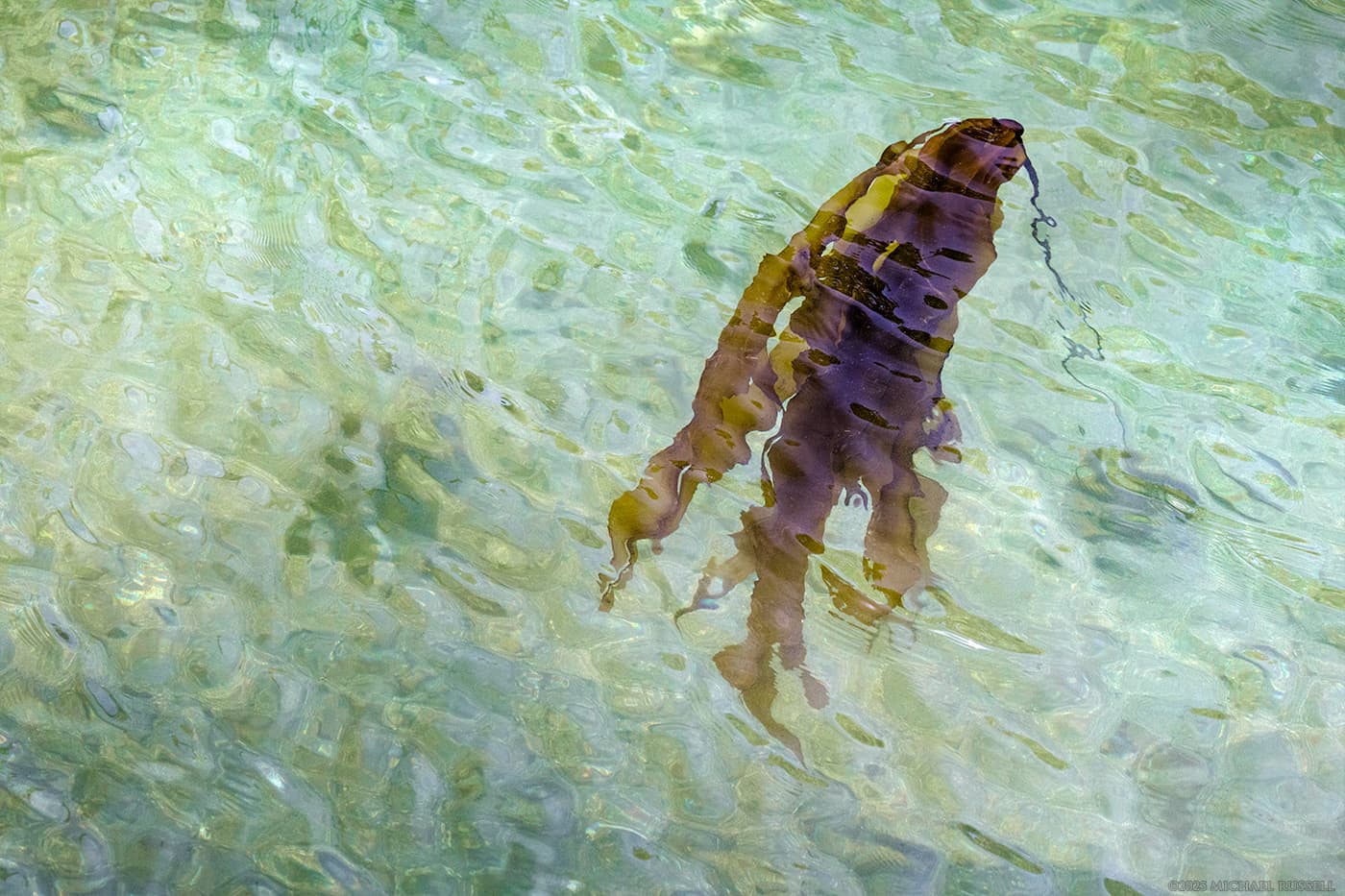
Bull Kelp (Nereocystis luetkeana) at Fulford Harbour (Purchase)

The second photo here was made just a few feet away. The sandy bottom is much lighter in colour, and help show off the structure of this Bull Kelp (Nereocystis luetkeana) which is also known as Bullwhip Kelp and Ribbon Kelp. Bull Kelp like this are anchored to the sandy bottom with a holdfast and come near the surface (and the light) via a long “branch” called a stipe. A bulb is attached to the stipe, and serves as a flotation device much like the vesicles on the Rockweed. You can see the stipe in the photo above, but most of the photo is showing the fronds or blades of the seaweed.

rockweed fucus distichus floating on the surface

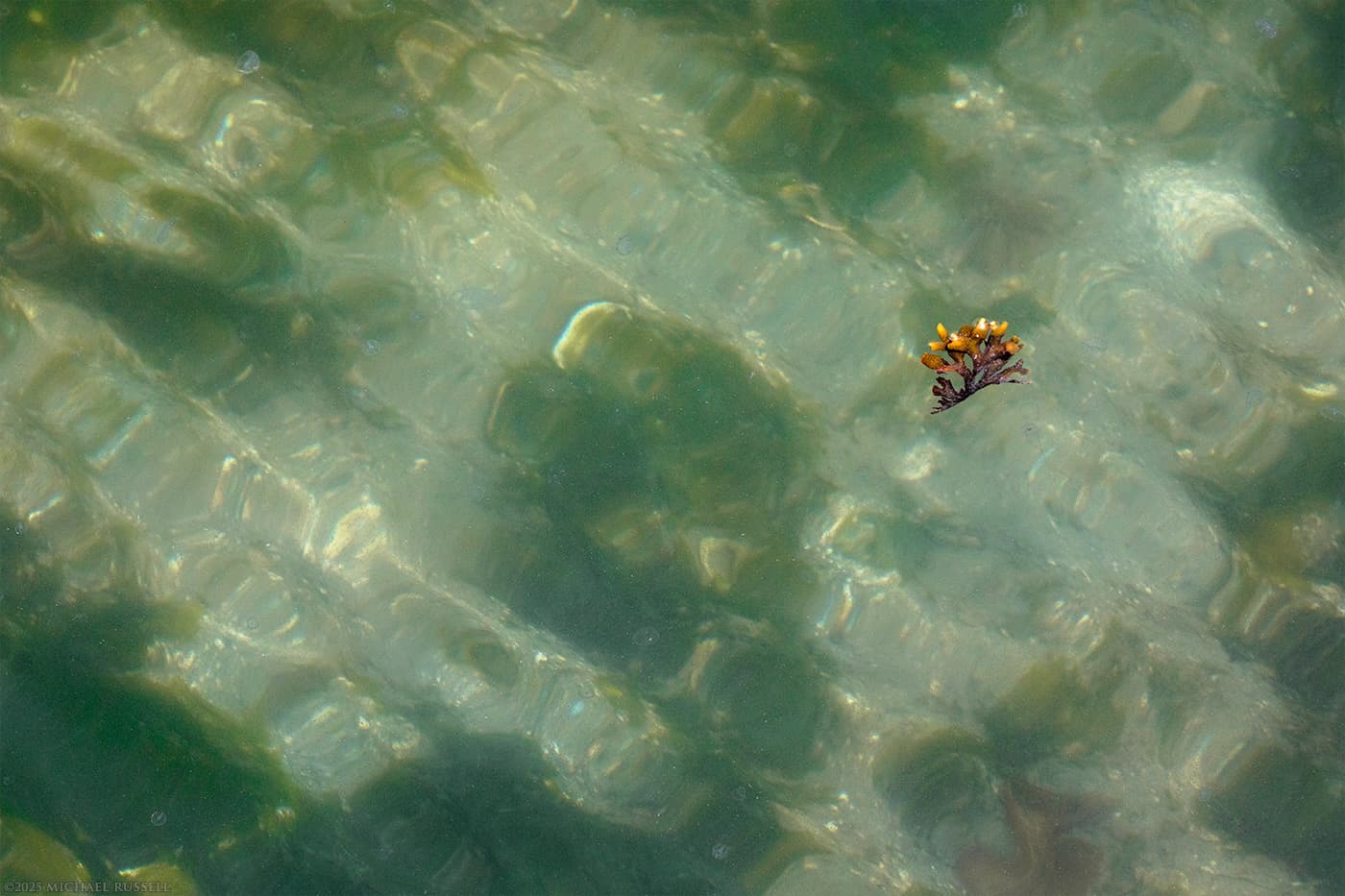
Rockweed (F. distichus) floating on the water at Fulford Harbour (Purchase)

The last photograph here is a much smaller piece of floating Rockweed against yet a different sandy bottom this time with darker sand and a lot of what appears to be species of green seaweeds.

More photographs from Fulford Harbour can be found in my Salt Spring Island Gallery.

Salt Spring Island Summer Trip

The Portlock Lighthouse on Prevost Island with Salt Spring Island and the Olympic Mountains (Washington State) in the background.

portlock point prevost island lighthouse gulf islands national park

The Portlock Lighthouse (automated) stands on the south side of Prevost Island (Purchase)

In my last post here I told the story of being followed by sheep at Ruckle Provincial Park. I have now published some other photographs from that trip, including the first photograph here of the Portlock Point Lighthouse. The Portlock Lighthouse (automated) stands on the south side of Prevost Island (part of the Gulf Islands National Park Reserve) between the mainland and Vancouver Island. It is one of the many great views one can take in on the way to Victoria from Tsawwassen. I’ve photographed the lighhouse before, and I am almost always on deck of the ferries looking to improve old photos and find new subjects. This time I was rewarded as a few elements lined up nicely. There are interesting clouds, the Olympic Mountains in Washington State, the lighthouse itself, the various rocky islands and… that sailboat in just the right place.

Duck Creek Park Rainforest

ferns and trees along duck creek rainforest on salt spring island

The rainforest along Duck Creek on Salt Spring Island (Purchase)

Duck Creek Park is a very nice, albeit small, park in the Vesuvius area of Salt Spring Island. As friends I often stay with live close by, I almost always visit this park in the evenings when the light in the forest is nice. On this trip there more was water in Duck Creek than usual, and the ferns and other plants on the forest floor were healthy. I made this photograph of the chaos in the forest as I’m trying to make more of these types of forest photographs. There are always tree branches, trunks, and various other elements going every which way, but that is part of the appeal of trying to find a composition here. Most of the tree species in this area were Red Alder (Alnus rubra), Western Red Cedar (Thuja plicata), and Bigleaf Maples (Acer macrophyllum) while Bracken (Pteridium aquilinum) and Sword Ferns (Polystichum munitum) are common on the ground.

View of Vesuvius Bay Beach on Salt Spring Island

view of vesuvius bay beach on salt spring island

View of Vesuvius Bay Beach on Salt Spring Island (Purchase)

-click to enlarge-

While I was waiting for a ferry to Vancouver Island from the Vesuvius area of Salt Spring, I wandered around and looked for various intertidal species. I saw a number of large jellyfish and sea stars. I made this wide panorama of the view of Vesuvius Bay Beach from the ferry terminal dock. I have photographed a number of subjects on this beach before, so having a photograph of the entire location was nice to obtain.

Red-breasted Sapsucker

red-breasted sapsucker at burgoyne bay provincial park

Red-breasted Sapsucker (Sphyrapicus ruber) looking over a series of sap wells in a tree trunk (Purchase)

I have photographed the Red-breasted Sapsucker (Sphyrapicus ruber) before, and most of those photos were also made in Salt Spring Island’s Burgoyne Bay Provincial Park. This time I wasn’t up on the hill in the forest, but down in the old farm field part of the park. I was heading back from photographing a few views from the shoreline, and found a number of bird species in the various hedgerows of Black Hawthorn (Crataegus douglasii), Garry Oak (Quercus garryana) and the invasive Himalayan Blackberry (Rubus armeniacus). Shortly after I was able to photograph a Rufous Hummingbird (Selasphorus rufus) for the first time (and in flight!) – I found this Sapsucker tending to its various sap wells. There were a lot of them in the surrounding trees, which was good news not only for the Sapsucker but also the Hummingbirds and various other bird and insect species which also use the wells for a food source.

For more photographs of Salt Spring Island visit my Salt Spring Island Gallery.

Niagara Falls in Goldstream Provincial Park

Niagara Falls at Goldstream Provincial Park in British Columbia, Canada.

niagara falls at goldstream provincial park

Niagara Falls at Goldstream Provincial Park (Purchase)

I don’t make it to Vancouver Island nearly often enough. After a recent trip to Salt Spring Island I decided to forgo my usual return route of Swartz Bay via Fulford Harbour, and headed out of Vesuvius to Crofton on Vancouver Island to drive to Swartz Bay near Victoria and see what kind of things were along the way. I didn’t really plan this, and left later in the day than I thought I would, but I did manage to do some exploring on the nearly 100km meandering drive I made through southern Vancouver Island. I had never driven south of Cowichan Lake in the past so this was interesting. The highlight of this drive was visiting Goldstream Provincial Park for the first time and and wondering what a waterfall with the audacity to be named “Niagara Falls” looked like.

niagara falls and fallen trees

Niagara Falls and Fallen Trees (Purchase)

I had seen “Niagara Falls” on the map and knew Goldstream Provincial Park was a big attraction in the area. However, I’d done pretty much zero trip planning for this so I was flying by the seat of my pants all afternoon and evening. I didn’t have time for much of a hike, so the small waterfall symbol next to the Malahat Highway itself looked promising. To say I was pleasantly surprised is an understatement. Niagara Falls on Niagara Creek in Niagara Canyon (they really like that name!) is a very pretty waterfall at the end of a canyon surrounded by large Bigleaf Maple trees. I was quite lucky with the conditions as well. It was supposed to be overcast much of the day but things started to clear up a bit just as I arrived at the falls. The sun came out here and there, but I was able to photograph the falls in quite favorable conditions.

Many waterfalls I have photographed suffer from the same “why is there always a log!” phenomenon, and this waterfall was no different. I really didn’t mind the trees that had fallen at the base of the falls and elsewhere in the canyon though. The large tree at the base made for an interesting foreground. Overall they do tell a story about what happens here during high water flow events. Clearly the volume of water that comes over this falls during storms and other events is sufficient to carry these large trees downstream and into the canyon.

pool at bottom of niagara falls

Pool At Bottom Of Niagara Falls (Purchase)

With a waterfall as famous as Niagara Falls in Ontario, I would have thought I’d find some explanation why this falls was named the same. I wasn’t able to find anything. There is an alternative name for the falls, but it is “Golden Niagara Falls” which is still pretty similar. The canyon the falls are in is called Niagara Canyon, and the creek is Niagara Creek. Perhaps someone just thought it was a cool name.

niagara falls and bigleaf maples at goldstream provincial park

Niagara Falls and Bigleaf Maples at Goldstream Provincial Park (Purchase)

The more famous falls in Ontario is 51 m (167 ft) high while the Goldstream Provincial Park version drops 47.5 meters (156 ft) – so they are actually pretty close in height. This is where the similarity ends, obviously. Judging from what I’ve seen of the experience around the falls in Ontario, I’d rather visit the falls on Vancouver Island!

For more photographs of British Columbia’s Provincial Parks, visit my British Columbia Provincial Park’s collection of galleries.

Views from the Ferry in BC’s Southern Gulf Islands

When I visit Vancouver Island or Salt Spring Island, I’m almost always on the ferry deck during the trip. Even in poor weather, the view from there is much nicer than from inside the ship, and I tend to walk around too. During Covid there has been a lot more people on deck than before, but most people still seem to be inside even when the weather is nice and warm. I usually have a camera in my hand when on the deck, and I thought I’d share a few recent photos from the trip between Tsawwassen BC and Salt Spring Island via Victoria (Swartz Bay).

Active Pass

The first photograph below is from Active Pass which connects the Straight of Georgia to Trincomali Channel in British Columbia’s Southern Gulf Islands. This is the Spirit of British Columbia on its way to Tsawwassen, passing my ferry on the way to Victoria. Mayne Island is in the background. Active pass is no longer a route for shipping traffic. There was a recent controversy with a fully loaded oil tanker transiting Active Pass near the ferries, which people did not take kindly to. The area is quite narrow and has history of bad outcomes with shipping traffic. In 1970 the Russian freighter Sergey Yesenin collided with the Queen of Victoria, killing 3 passengers. After the oil tanker used the pass in 2021, the the Pacific Pilotage Authority banned the practice. That said, I enjoy the Active Pass part of the journey. There are a lot of waterfront homes to look at, often some wildlife, and there is often another BC Ferry passing nearby as well as smaller vessels. The photograph below shows the BC Ferry Spirit of British Columbia passing my ferry in Active Pass with Mayne Island in the background.

spirit of british columbia in active pass

BC Ferry Spirit of British Columbia in Active Pass (Purchase)

I’m sure those of you who have taken the Active Pass route on multiple occasions are familiar with this waterfront home with a nice view on Galiano Island. I made this photograph due to all the Gulls feeding off whatever foodstuffs have been churned up by another passing ferry. Active Pass can be a good place to spot wildlife, with seals, gulls, Orcas, and Bald Eagles as frequently spotted species.

gulls forage in the wake of a passing ferry off galiano island in active pass

Gulls Feeding in Active Pass near Galiano Island (Purchase)

At the eastern entrance to Active Pass is another structure many will be familiar with – the Active Pass Lighthouse (also known as the Georgia Point Lighthouse) on Mayne Island. The lighthouse at Georgia Point was built in 1969 and is in what is now called Georgia Point Heritage Park. The Lightkeeper’s house was built in the 1940’s. This northeastern point on Mayne Island has been a light station since 1885, and has been home to 3 different lighthouses in that time.

active pass lighthouse on mayne island

The Active Pass Lighthouse on Mayne Island (Purchase)

Southern Gulf Islands

Much of the trip between Tsawwassen and Swartz Bay in Victoria winds its way past many of the Southern Gulf Islands of British Columbia including Mayne Island, Galiano Island, Prevost Island, North Pender Island, and Salt Spring Island. Salt Spring is often my destination, and is the largest of the islands in the area. A short 30 minute ferry ride from Swartz Bay to Fulford Harbour on Salt Spring has some nice views as well, and I’m usually looking off the side of the much smaller ferry that completes this trip. This is the view looking back at Mount Maxwell and Fulford Harbour on the passenger/vehicle ferry Skeena Queen having just left Fulford Harbour.

mount maxwell from fulford harbour salt spring island

Mount Maxwell an Fulford Harbour on Salt Spring Island (Purchase)

-click to enlarge-

This photo was made just east of Active Pass showing the Spirit of Vancouver Island about to pass the ferry I was on at the time. The mountains in the background are Crown Mountain and Grouse Mountain. Always interesting in a photo like this to see that the buildings along the water in the background are missing the lower parts, due to the curvature of the earth (they are approximately 35km away).

spirit of vancouver island salish sea active pass

BC Ferry Spirit of Vancouver Island in the Salish Sea (Purchase)

While I have yet to visit Mayne Island I have looked at some of the attractions on the island from the ferries. In addition to the Active Pass Lighthouse I usually keep an eye out for the Springwater Lodge shown below. The Springwater Lodge was established in 1892 at Miner’s Bay and became a common stopover spot for mine workers heading to the Fraser River and Caribou Gold rushes.

springwater lodge mayne island miners bay

Springwater Lodge at Miner’s Bay on Mayne Island (Purchase)

I often photograph other boats from the ferry and sometimes I am able to find some information on them when editing the photographs later. This particular sailboat is named “The Westerly” and is a Santa Cruz 70 racing yacht I photographed off the coast of Vancouver Island in Satellite Channel near Swartz Bay – with Cobble Hill in the background. “The Westerly” has competed in races such as the Pacific Cup in the past.

racing yacht westerly near swartz bay vancouver island

Santa Cruz 70 racing yacht offshore of Cobble Hill (“The Westerly”) (Purchase)

More photos from this area can be found in my Vancouver Island & Southern Gulf Islands Gallery.

Wildflowers on Salt Spring Island

A Fairy Slipper Orchid (Calypso bulbosa var. occidentalis) blooming on the forest floor of Ruckle Provincial Park on Salt Spring Island, British Columbia, Canada.

fairyslipper orchid calypso bulbosa

Fairy Slipper Orchid (Calypso bulbosa var. occidentalis) Flower (Purchase)

During my trip to Salt Spring Island in April, I visited Ruckle Provincial Park and spent many hours walking around, hiking, and taking in the views from various shoreline trails. Initially I spent about 45 minutes photographing Ruckle Heritage Farm which I outlined in my previous post. After photographing the farm I headed into the forest and shoreline trails to see what I could find. There are great trails in Ruckle Provincial Park that give a variety of views ranging from farmland, ocean, forests, and beaches. One thing that especially caught my eye during that walk was the variety of wildflowers. Most of these species I’d not seen on the mainland, and were new to me entirely.

The first photograph here is a Fairy Slipper (Calypso bulbosa var. occidentalis) which is also known as Calypso Orchid or Venus’s Slipper. These orchids have no nectar, and trick Bumblebees into pollinating them through deceptive scents and shapes that mimic nectar containing flowers. I don’t think I’ve seen any orchids in the wild before, so this was a nice find. The entire flower and stem shown here was maybe 5cm (2inches) tall at the most. Very easy to miss while walking by in the forest!

slender toothwort - cardamine nuttallii

Slender Toothwort (Cardamine nuttallii) Flowers (Purchase)

When I photograph almost anything from buildings to animals, plants, mountains, lakes, creeks etc – I always try to find the proper name for the location or species. Wildflowers I’ve never seen pose a bit more of a challenge, as I’m not quite as sure where to start in a guidebook or other ways of identifying a species. Another hurdle can be that many species look nearly alike, and sometimes identification would have to come down to characteristics not revealed in a photograph. In the case of the variety of Cardamine species I found on Salt Spring, a lack of good photos of the leaves didn’t help me out any! I really need to engrave something like “photograph the leaves too!” on the back of my camera so I have those as a tool for identifying later at home. The Cardamine above I am fairly sure is a Cardamine nuttallii or Slender Toothwort. This species also goes by the names Beautiful Bittercress, Nuttall’s Toothwort, and Palmate Toothwort. I also photographed Angled Bittercress (Cardamine angulata). There are a few other Cardamine species that all look very similar which made narrowing these down a big of a lengthy challenge! Mountain peaks are comparatively easy.

white fawn lily - erythronium oregonum at ruckle provincial park

White Fawn Lily (Erythronium oregonum) (Purchase)

One species I had not seen before, but was anticipating seeing while on Salt Spring were the White Fawn Lilies (Erythronium oregonum). I was not disappointed – they were very frequently seen in Ruckle Provincial Park. Not a easy plant to photograph I discovered, especially when there is a bit of wind. The flowers point down so I made a lot of exposures (read: way too many) trying various angles. I liked the photograph above as it is backlit, and the sunlight shining through highlights the orange and yellow colours near the centre of the flower. The photograph below shows the White Fawn Lily in the kind of environment I usually encountered them – underneath some tree cover (in this case a Garry Oak) and mixed in with grass and other plants. Their usual environment in southern British Columbia is along the coast at lower elevations in forests and open meadows. This species is also known as the Giant White Fawn Lily.

white fawn lily - erythronium oregonum on salt spring island

White Fawn Lily (E. oregonum) underneath a Garry Oak (Purchase)

I was attracted to these Large-flowered Blue-eyed Mary (Collinsia grandiflora) flowers (below) initially due to their blue color but then because of the large amount of Bumblebees zipping about from flower to flower. The flowers are quite small, but were growing in large groups, usually mixed in with various mosses, on the more open spots along the rocky shoreline at Ruckle. Bees on flower photos are not something I normally attempt in a park – it can be a low percentage of a success much like other fast moving wildlife, but I couldn’t resist this time. It all worked out as this particular Bumblebee was moving from flower to flower a bit slower (and close to where I was on the trail), and I was able to make a sharp photograph as it collected nectar from these flowers. The yellow sacs you see on the bee’s back legs are called Corbiculae or Pollen baskets and are used for collecting pollen.

bumblebee on large-flowered blue-eyed mary flowers at ruckle provincial park

Bumblebee on Large-flowered Blue-eyed Mary (Collinsia grandiflora) flowers (Purchase)

Much like the Fairy Slipper in the first photograph, I’m lucky to have spotted this Fringed Redmaids (Calandrinia ciliata) flower nestled in the mosses and grasses in an open area along the shoreline. Not a species I was familiar with, but they are said to be quite common on the Southern Gulf Islands.

fringed redmaids flower on salt spring island

Fringed Redmaids (Calandrinia ciliata) Flower (Purchase)

I came across this Chickweed Monkeyflower (Erythranthe alsinoides) blooming in an open area in the campground at Ruckle Provincial Park. I’d previously photographed Harvest Brodiaea in almost the same spot a few years ago. This Monkeyflower is sometimes listed as Mimulus alsinoides or Wingstem Monkey-flower.

chickweed monkeyflower - erythrante alsinoides

Chickweed Monkeyflower (Erythranthe alsinoides) (Purchase)

I also had some luck spotting these Small-flowered Woodland-Star (Lithophragma parviflorum) flowers on the forest floor. While they are larger than the orchid, this was the only one I saw. L. parviflorum is also known as the Small-flowered Fringecup or Prairie Star, and is part of the Saxifrage family.

small-flowered woodland-star flower - lithophragma parviflorum

Small-flowered Woodland-Star (Lithophragma parviflorum) (Purchase)

I’m cheating slightly with the photo of a Common Stork’s-Bill (Erodium cicutarium) flower below, as I didn’t photograph it at Ruckle. The day before I was in Burgoyne Bay Provincial Park with my friend who lives on the island and spotted this one at the base of some Garry Oaks. The Stork’s Bill is another flower I don’t think I’ve seen before. Unfortunately, it is an invasive weed from Europe and not native to British Columbia. For some reason it always feels slightly disappointing to look up a species you’ve just discovered only to find it the name starts with “common”! While we were in Burgoyne Bay my friend pointed out some birds in the water along the shore he hadn’t noticed before. Common Mergansers, of course.

common storks-bill - erodium cicutarium

Common Stork’s-Bill (Erodium cicutarium) (Purchase)

For more photographs of Salt Spring Salt Spring Island, Ruckle Provincial Park, and the island’s wildflowers, visit my Salt Spring Island gallery.

Ruckle Heritage Farm on Salt Spring Island

A Jersey Cow named Alison grazes in a pasture by a barn built in 1935 at Ruckle Heritage Farm.

alison the jersey cow grazing at ruckle heritage farm

Jersey Cow Name Alison Grazes in a field at Ruckle Heritage Farm (Purchase)

In April I was again on Salt Spring Island and was happy to visit Ruckle Provincial Park for the first time without rain! Every other time it has rained on me, and while it is still a beautiful park to visit in the rain, I’d prefer to keep myself and my equipment dry. I took advantage of this opportunity and walked in Ruckle Provincial Park and Ruckle Heritage Farm for around 7 hours. I had no specific photography goals, but I wound up photographing Ruckle Heritage Farm and a lot of new (to me) wildflowers. My intention had not included making a lot of photos of the farm, but with the lack of rain, and some animals out and about, I wound up spending about 45 minutes looking at the various scenes around the farm and Henry Ruckle Farmhouse (built in the 1870’s). The first photograph above is of the David Henry Ruckle Barn (built in 1935) with a Jersey Cow named Alison (according to their website) grazing nearby.

barn and poultry coop at ruckle heritage farm

Barn (1935) and Poultry Barn (1930) at Ruckle Heritage Farm (Purchase)

-click to enlarge-

Ruckle Farm was started in 1872 by Henry Ruckle and continues as Ruckle Heritage farm within Ruckle Provincial Park on Salt Spring Island. The photograph above shows the David Henry Ruckle Barn (built in 1935) which is currently used for machinery and hay storage. The chicken barn on the right was built in 1930 originally as a chicken and sheep shed. It now appears to be used exclusively for the poultry – chickens and turkeys. The Ruckle Farm property was purchased by the Province of British Columbia in 1973 for the creation of Ruckle Provincial Park. A life tenancy agreement was created which gave the family the right to continue to occupy the farm area. The life tenancy agreement expired in 2019 and now BC Parks is responsible for the farm. Mike and Marjorie Lane operate the farm currently and product fresh produce, chickens, turkeys, eggs, lambs, wool, and other products.

a sheep grazing at ruckle heritage farm

A Sheep Grazing in a Pasture (Purchase)

The sheep at Ruckle Heritage Farm certainly seem used to visitors. None have seemed concerned when I photographed them from nearby, and these two below even stuck their heads through a split rail fence. Perhaps they are accustomed to attention from farm guests.

sheep looking through a split rail fence at ruckle heritage farm

Sheep looking through a split rail Fence (Purchase)

This small barn looks to to mostly be used for sheep. While many of the trees from a once large orchard are gone, some Apple trees remain.

sheep barn at ruckle heritage farm

Sheep Barn and the Surviving Fruit Trees of an Old Orchard (Purchase)

This fruit tree in the Ruckle Heritage Farm orchards is covered with what may be Common Witch’s Hair (Alectoria sarmentosa), often referred to as “Old Man’s beard”. Frequently and erroneously referred to as moss, these species are actually a lichen. I’ve seen many trees covered in similar lichen on Salt Spring, it seems rather common.

fruit tree and witchs hair lichen

Common Witch’s Hair (Alectoria sarmentosa) Covers a Fruit Tree (Purchase)

For more photographs from Ruckle Heritage Farm visit the Ruckle Provincial Park gallery.

Salt Spring Island Miscellaneous

There was great leaf foliage colour this past fall and I was able to take advantage of a lull in the Covid situation to visit some friends on Salt Spring Island. Before my trip I looked through the photographs I had already made on Salt Spring and tried to think of the kind of photographs that represented the area. That question is probably better answered by someone who lives there but from my perspective, farms, ocean scenes, boats, beaches, and nature in areas like the provincial parks came to mind. At least from within the range of photographs I usually make – I’m sure there are interesting street scenes and photos with people in them to be made around the market but that isn’t usually my thing. My fall trip was like most of my Salt Spring trips – I tend to bring the rain with me. I did visit two provincial parks while there, and even spent about 20 minutes at Ruckle Provincial Park which is the only visit I’ve made there without rain falling. I hope to visit that park again on my next visit.

Burgoyne Bay Provincial Park

Burgoyne Bay Provincial Park is an area I visit on every trip to Salt Spring Island. It is easy to access and it is a favourite of mine as it has a view of Mount Maxwell as well. I’ve already shared one photograph I made of Mount Maxwell in my Top 10 Photographs of 2021 (#3) post late last year and have included it again below.

I’ve developed an affinity for photographing old barns and buildings and these two old farm structures are ones I enjoy at Burgoyne. This time I was able to improve on older photographs as the fall leaves on the Bigleaf Maples (Acer macrophyllum) in the area were nearly at peak colour. This barrel-roof shed in the photo below was built by Richard Maxwell between 1900 and 1910 on his farm near Burgoyne Bay. The Maxwell Farm, later becoming the Larsen Farm, is now part of Burgoyne Bay Provincial Park. The shed was built for storage of large farm equipment and has two access doors on the Burgoyne Bay Road side of the building.

historic farm building at burgoyne bay on salt spring island

Barrel-Roof Shed built my Richard Maxwell between 1900 and 1910 at Burgoyne Bay (Purchase)

The Root Cellar is also right next to Burgoyne Bay Road and was built by Maxwell in 1901. The Root Cellar was used for storage of crops such as such as apples, carrots, turnips, potatoes, and squash. I always stop to take a look, and much prefer this photograph with the nice fall leaves versus an older one with no leaves on the trees. Maybe some day I’ll get a photograph of this building in the snow.

historic root cellar at burgoyne bay on salt spring island

Root Cellar (built 1901) at Burgoyne Bay on Salt Spring Island (Purchase)

I photographed this houseboat anchored in Burgoyne Bay while the rain poured down. There were not many boats anchored in the bay when I visited in October, likely owing to the season. Living there you would wake up to beautiful views. Being the fall season I was mostly drawn to the backdrop of Bigleaf Maple trees and the houseboat made a good main subject in front of them.

houseboat anchored at burgoyne bay on salt spring island

Houseboat in the rain at Burgoyne Bay on Salt Spring Island (Purchase)

One of the many reasons to enjoy Burgoyne Bay are are views of Mount Maxwell (Hwmet’atsum). The clouds cleared around the mountain when I was walking a trail to the bay, and were rather dynamic which required some patience. Of the many exposures I made of various cloud positions I like this one the best as the character of the peak shows through with a border of clouds around it.

clouds around mount maxwell on salt spring island

Mount Maxwell in the Clouds (Purchase)

Fernwood Dock

When visiting Salt Spring Island I often drive North Beach Road and Walkers Hook Road along the northeast side of the island. It is a nice drive with many ocean views of the Houston Passage and Wallace Island as well as Galiano Island in the Trincomali Channel. At Fernwood Point there is the 122m (400 ft) long Fernwood Dock which extends 400 feet from the shore. The rocky beach on either side of the dock is a great spot to see anenomes and other intertidal species in the tide pools.

fernwood dock on salt spring island

Fernwood Dock on Salt Spring Island (Purchase)

Cranberry Valley

Cranberry Valley is an area of Salt Spring Island with a lot of small farms and acreages. I photographed these sheep taking shelter from some heavy rain with a nice backdrop of Bigleaf Maples behind them.

sheep on a small farm at cranberry valley on salt spring island

Cranberry Valley Sheep on Salt Spring Island (Purchase)

You can view more photographs of the island in my Salt Spring Island Gallery.

Fulford Harbour on Salt Spring Island

The Skeena Queen docked at the BC Ferry terminal at Fulford Harbour on Salt Spring Island, British Columbia, Canada.

fulford harbour salt spring island bc ferry skeena queen

Fulford Harbour – Skeena Queen at BC Ferries Terminal (Purchase)

Fulford Harbour on Salt Spring Island is one of the 3 areas on the island with a BC Ferries terminal (in addition to Vesuvius and Long Harbour). I photographed the Skeena Queen dropping off passengers at Fulford Harbour during my last trip there in early June. This BC Ferries route goes between Fulford Harbour and Swartz Bay (near Victoria) on Vancouver Island. I like the Fulford Harbour area – it isn’t as busy as Ganges and offers some nice views of the water from the village itself as well as from Drummond Park. Fulford also offers a cafe and bakery, a restaurant, various artist studios, and a country store. During a previous trip I photographed the historic St. Paul’s Catholic Church (1885) which is near the village.

mute swan adult at fulford harbour salt spring island

Mute swan (Cygnus olor) at Fulford Harbour (Purchase)

This Mute Swan (Cygnus olor) immediately swam over when it saw me standing near the shoreline. I presume people feed the small population of the non-native Swans here and this one was heading over for a free snack. It wasn’t going to get anything from me, but I did take the opportunity to make a photograph. This was right near the outflow of Fulford Creek into Fulford Harbour which is probably a good place to forage for tasty morsels in a more natural way.

fulford creek estuary on salt spring island

Fulford Creek Estuary (Purchase)

I made this photograph of Fulford Creek near the old site of the Fulford Inn. Fulford Creek is home to one of the the largest salmon runs in the Southern Gulf Islands. Home to Coho (Oncorhynchus kisutch) and Chum (O. keta) Salmon as well as Cutthroat Trout (O. clarkii) the creek fish populations are threatened mostly due to low water flows in the summer. I had just photographed the ferry above and failed to judge when the disembarking traffic was going to be going by, so I was stuck on the wrong side of the road for a while before I could get back to my car!

More photographs from my trips to Salt Spring can be found in my Salt Spring Island Gallery.